Learning Disentangled Representations with Identifiable Diffusion Models
Project Report
Project Report 1
Project Report 2
identifiable-diffusion
Abstract
This work introduces a novel framework that combines the Denoising Diffusion Probabilistic Model (DDPM) with an identifiable Variational Autoencoder (iVAE) for disentangled representation learning. Our approach leverages the strengths of diffusion models in capturing data distributions across scales and the iVAE’s capability to learn identifiable latent representations. Through extensive quantitative experimentation using various disentanglement metrics to compare our model to baseline models, and a qualitative evaluation on the Shapes3d dataset, we demonstrate our method’s ability to generate disentangled representations.
[!TIP] The project uses
pytorch-lightning’s CLI (link) functionality to avoid writing boilerplate code for argument parsing.
The training script for the Shapes3DVAE and Shapes3DIVAE baselines thus be ran like:
python src/train.py \
 --model=shapes3d.models.Shapes3DVAE \
 --model.coeff_kl=1 \
 --trainer.max_epochs=1
any other arguments to either Trainer or the model classes can be provided as --model.foo=bar or --trainer.foo=bar
To run the training script for the combined iVAE+DDPM model (Shapes3DDisentangledDiffusionCombined), execute:
python src/train.py \
 --model=shapes3d.models.Shapes3DDisentangledDiffusionCombined \
 --trainer.max_epochs=10 \
 --model.dataset_in_memory=True \
 --model.batch_size=32 \
 --model.lr=2e-4 \
 --model.grad_clip=-1 \
 --model.coeff_rec=0.1 \
 --model.coeff_kl=0.0005 \
 --model.dataset_modulate_mean=false \
 --model.plot_interpolations_at_epoch_end=true
Pointers to important files
The base models can be found under src/base/models.py. Here we created the class BaseDisentangledDiffusionCombined which combines an iVAE with a DDPM.
We use code from https://github.com/yang-song/score_sde under the directory src/temp_diffusion for the VPSDE in src/temp_diffusion/sde_lib.py and the layers of the DDPM in src/temp_diffusion/layers.py.
Other important files are src/base/losses.py and src/base/layers.py where we define respectively the loss function for the DDPM and the DDPM’s layers including the conditional from the iVAE.
Generating samples (inference)
To sample images using a trained iVAE+DDPM model, you can either run model.plot_interpolations(), which creates a grid of conditional samples by interpolating each latent dimension and is also used to log images to wandb during training, or you can use the model.ancestral_sampling(batch_size=1, T=600, z=None, same_xN=False, seed=0) function that enables more control for the generations. For example, you can vary the number of diffusion time steps and pass a conditioning vector z.
Using other datasets
The model currently is trained on the shapes3d dataset. In order to use different datasets, the model can easily be adapted by defining a new base model for that dataset (refer to _BaseShapes3DModel in src/base/shapes3d) and then inheriting from that base model, i.e.:
class Shapes3DDisentangledDiffusionCombined(
    _BaseShapes3DModel, base_models.BaseDisentangledDiffusionCombined
):
    pass
Diffusion of a sample batch using the iVAE+DDPM
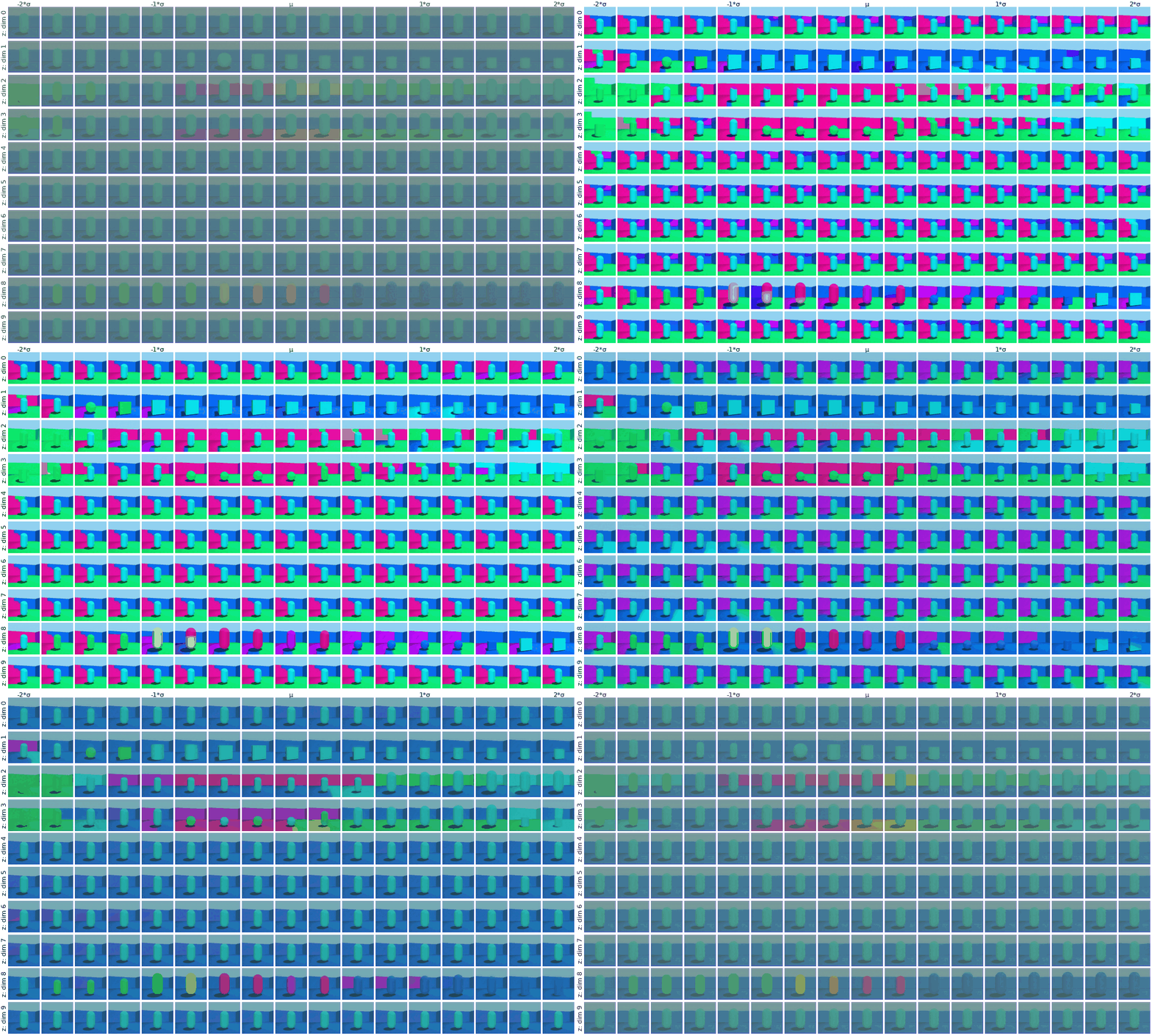 Each row shows one interpolated latent dimension (while all other dimensions are fixed).